One operating model for profitable growth
Platform metrics can improve while the business stands still. Our framework connects acquisition, customer value and profit into a growth system that can actually scale.
.jpg)
Brands don't scale on marketing alone.
They scale through clear direction, strong systems og better decisions.
















What problems does the framework solve?
Most companies do not need more activity. They need a clearer order of operations.
These are the problems we typically see when growth becomes more expensive, slower or harder to explain.
Paid Social, Google, SEO, email and e-commerce are often optimised independently.
That creates activity, but not necessarily progress. When nobody owns the whole system, marketing becomes a collection of disconnected initiatives instead of one coherent growth model.
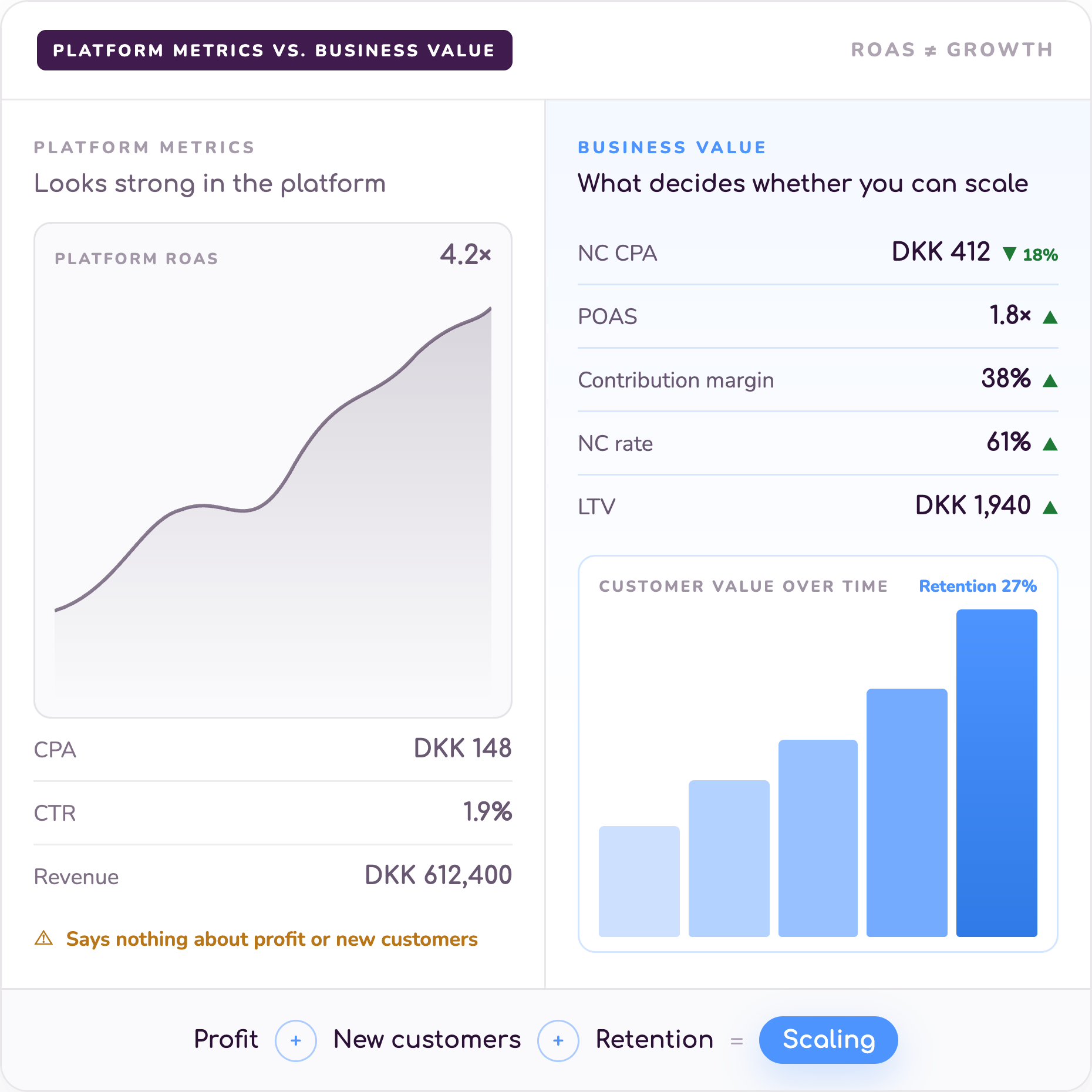
Platform metrics can improve while the underlying business gets weaker, especially when revenue comes from existing demand, discounts or customers who were already close to buying.
We therefore look at what it actually costs to acquire a new customer, how much growth is incremental and whether those customers become more valuable over time.
Many brands keep producing more. More hooks, more videos and more angles, without a clear system for what each asset is supposed to achieve.
Creative should not simply fill the ad account. It should create understanding, memory, demand and better buying decisions.
Many brands allocate most of their budget to people who are already close to buying.
It can work in the short term, but over time the addressable market gets smaller, competition gets harder and growth becomes more expensive.
The next layer of growth often sits higher in the funnel, with the people who have not yet decided which brand to trust.
If customers cannot quickly understand why the brand exists, what it stands for and why it matters, performance becomes more expensive.
Brand is not just visual identity. It is about building repeatable memory in the market, so the brand comes to mind when the need appears.
Conversion is often reduced to buttons, speed and checkout. Those matter, but they are only part of the equation.
Conversion starts before the click, with the message, the angle, the offer, the landing experience and the expectations created before the customer ever reaches the site.
Acquisition can create momentum. But if customers do not return, the same growth has to be bought again and again.
Retention makes the first purchase more valuable. Email, SMS, customer journeys, product logic and repeat purchase therefore need to be treated as part of performance.
Revenue is not enough. More orders are not enough. Higher spend is not enough.
Growth has to be supported by the economics underneath it. Profit, contribution margin, customer value and cash flow need to influence the decision before the business scales.
From marketing activity to business value
Most companies start with more. More ads. More content. More campaigns.
We start with the order of operations.
Strategy sets the direction. Demand creates momentum. Conversion turns interest into revenue. Retention compounds customer value. Profit determines what can actually scale.
When all five work as one system, growth becomes repeatable instead of accidental.
.png)
The five building blocks of the framework
A framework only works when the parts work together.
We do not see strategy, demand, conversion, retention and profit as separate disciplines. They are five parts of the same commercial system.
When one part breaks down, growth becomes more expensive. When all five reinforce each other, it becomes easier to acquire new customers, increase their value and scale with greater control.
Strategy is not a long document. It is knowing what needs to be prioritised first and why.
We start with the business. Where is the potential? What is constraining growth? Which customers should be won? What can the business afford to pay for a new customer? And what does the brand need to become known for if growth is going to hold over time?
Traffic is not the objective. The objective is to create demand among the right people before they are ready to buy.
That requires creative with clear intent. Not simply more volume. Every angle, ad and campaign needs a defined role in making the brand easier to understand, remember and choose.
Conversion begins before the customer reaches the webshop. It starts with the message, the angle, the offer and the expectation created before the click.
That is why we look across landing pages, tracking, webshop structure, feeds and checkout as one connected journey. The less friction between interest and purchase, the more value the business gets from demand it has already paid to create.
Acquisition creates momentum. Retention determines whether that momentum continues to make economic sense.
If a customer only buys once, the same growth has to be purchased again. We therefore connect email, SMS, automation, customer journeys, product logic and repeat purchase, so the first order becomes the beginning of more value.
Revenue is not enough. ROAS is not enough. More orders are not enough.
Profit determines what can actually scale. We connect performance with contribution margin, NC CPA, customer value and incremental growth, so additional budget strengthens the business rather than simply creating more activity.
ROAS does not tell you whether you are creating new customers
A high ROAS can come from branded traffic, remarketing, discounts or customers who were already close to buying. It can look strong inside the platform without actually expanding the market.
We separate revenue that was already close to converting from growth that is genuinely being created. What does a new customer really cost? How much of the growth is incremental? Which new segments can be opened without paying for the same demand repeatedly?
NC CPA and genuinely new customers
Incremental growth over reactivated demand
Prospecting, creative and channels that open new segments
Once the real cost of a new customer is clear, it becomes much easier to decide where budget should increase, where it should decrease and what needs to be built before the next stage of scale.
Services are tools.
The system is what drives growth.
The individual disciplines should not operate in isolation. Each one should solve a different part of the same commercial problem.
Demand needs to be created. Intent needs to be captured. Interest needs to convert. Customer value needs to compound. Profit needs to be measurable.
That is when individual services become a growth system.
.png)
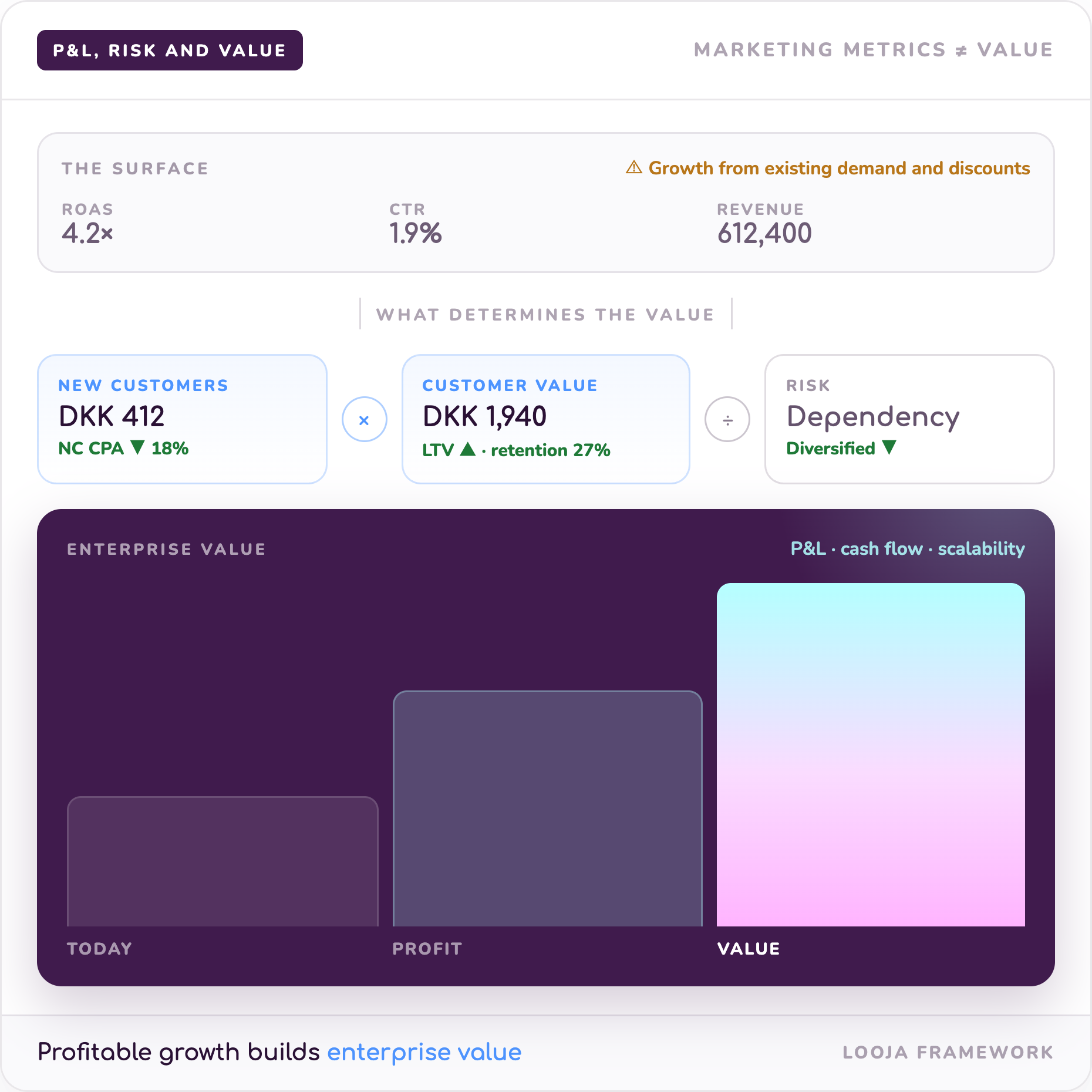
Strong marketing metrics do not always mean a stronger business
If growth depends on existing demand, constant discounts or a small number of winning campaigns, the platform numbers can look strong while the business becomes increasingly dependent on them.
That is why we evaluate marketing further down the P&L. What does it cost to acquire new customers? How much value do they create? Where does risk sit in the model? And what can genuinely scale without putting pressure on the economics of the business?
NC CPA and new customer growth
LTV, retention and customer value
P&L, cash flow and risk
The goal is not to make marketing look good. The goal is to build a business that becomes more valuable as it scales.
We don't just advise brands. We have skin in the game.
We build brands with our own capital, our own cash flow and the same commercial decisions our clients face every day. Product, brand, community and performance all accountable to the same business.
.jpg)

From startup to a profitable multi-million business
Product, positioning and demand built from the ground up
A community of thousands of active members
A growth system built for profit, learning and scale
Let’s talk about your next stage of growth



What we look at first
- Where the real growth potential is
- What is holding it back
- What the next right move is
Certified by the platforms we work with every day